
Let’s be honest for a second: followers don’t drive revenue. Buyers do.
Learning how to turn social media followers into customers starts with a mindset shift, and it’s the one most brands overlook. A trend moves fast, a team jumps on it, and somewhere along the way, someone quietly tells themselves, “If we get the followers, the sales will naturally follow.”
For the vast majority of purpose-driven businesses, it simply doesn’t work that way. Chasing algorithms and viral audio might inflate a metric count, but it rarely builds a legacy. Passive entertainment-seekers are looking for a quick distraction, not a solution to a problem. High-intent buyers, by contrast, use social media with a clear purpose. If you want to transform casual scrollers into actual customers, the shift has to move away from empty entertainment and toward something with real architecture: value-driven Edutainment.
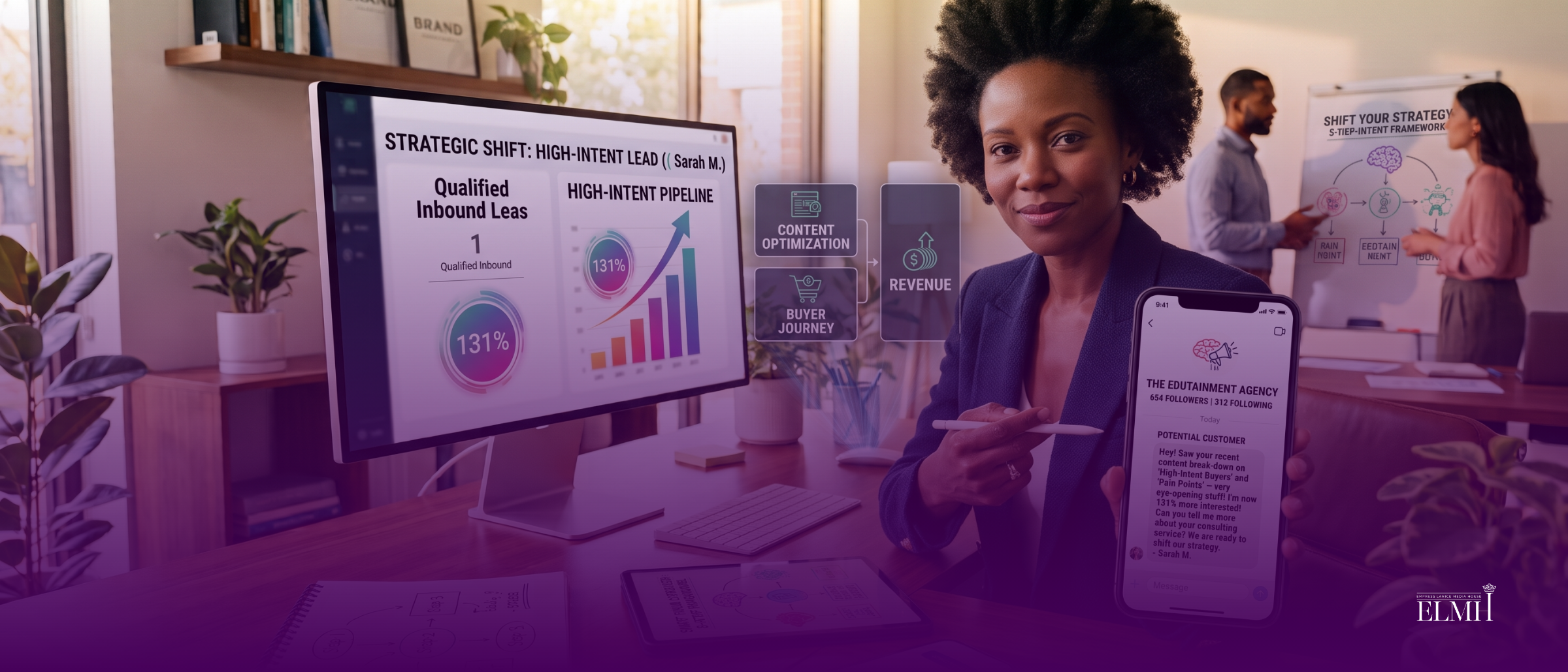
The data backs it up. According to marketing technology company Conductor, when a brand delivers early-stage educational content, consumers are 131% more likely to purchase from that brand on the spot.
The Proven Framework for How to Turn Social Media Followers Into Customers
Shifting from vanity metrics to serious conversions doesn’t require flashy editing or viral gimmicks. It requires structure. Below is the proven, three-step framework ELMH uses to architect a brand’s social presence around the people who are actually ready to buy.
Step 1: Speak Directly to the Pain Point
Resist the urge to sell right out of the gate. Instead, name the exact friction, frustration, or discomfort your ideal customer is living with today. When someone scrolls past content and feels completely understood, trust is established before a single product is mentioned.
Step 2: Provide Edutainment
Once the problem is named, educate your audience on the mechanics of the solution — clearly, engagingly, and without friction. Give away real insight for free. This is how a brand earns authority in its space, rather than blending into the noise as just another vendor.
Step 3: Make a Frictionless Offer
Finally, connect the education directly to what you sell. Skip the vague “link in bio” with no context. Show your audience, explicitly, how your product or service is the direct answer to the exact pain point named in Step 1.
The Framework in Action
Please note: The examples below use fictitious products and services.
Health & Wellness
Pain point: “Why your lower back aches after a long desk job.”
Edutainment: Two quick, effective desk-side mobility stretches for instant relief.
Offer: “Need deeper, long-term support? Grab our lower Ergonomic Lumbar Cushion — link in bio.”
Food & Beverage
Pain point: “Tired of the 2 PM coffee crash and the afternoon jitters?”
Edutainment: The nutritional science of L-theanine in premium matcha, and how it delivers sustained focus without the insulin or cortisol spike.
Offer: “Upgrade your afternoon ritual. Shop our Organic Matcha Blend below.”
Educational Institutions
Pain point: “Is your child getting lost in an overcrowded classroom?”
Edutainment: How smaller class sizes and individualized attention correlate directly with academic confidence and stronger testing outcomes.
Offer: “Give your child the environment they deserve. Download our Campus Info Guide or schedule a private tour.”
Building the Foundation: Aligning Content with Commerce
Understanding how to turn social media followers into customers still requires balance. High-value education and light trend participation can coexist, but every piece of content has to align with your brand’s core values and long-term vision. Social media is a tool for growth, not a stage for distraction. What you publish should build toward your goals, never subtract from them.
Stop optimizing for people who were never going to buy. Start building for the ones who already are.
If you’re ready to architect a purposeful, conversion-focused content strategy rooted in real revenue growth, not just reach, that’s exactly the kind of work we do inside Content Marketing | The Resonance. Let’s build it together.
Frequently Asked Questions
How long does it take to turn social media followers into customers?
Most brands see early engagement shifts, comments, saves, and DMs from genuinely interested buyers, within the first few weeks. Measurable conversion lift typically builds over 60 to 90 days as the strategy compounds.
What does the process of building this kind of strategy actually look like with ELMH?
It begins with a discovery conversation to understand your brand’s pain points, audience, and goals, followed by a content architecture built around the Pain Point, Edutainment, Offer framework, and ongoing refinement as data comes in.
How much does it cost to work with ELMH on a content strategy?
Investment varies by brand, scope, and discipline involved. Specific numbers are shared during a discovery call, where we can scope the right approach for your goals.
Is this approach right for a brand that’s just starting to build its social presence?
Yes. Learning how to turn social media followers into customers is often most powerful early on, since it builds trust and authority from the very first post rather than chasing reach that doesn’t convert later.
Does this framework work for service-based businesses, or only product brands?
It works for both. The Pain Point, Edutainment, Offer structure applies whether you’re selling a product, a service, or an experience, since the mechanics of trust-building stay the same.